
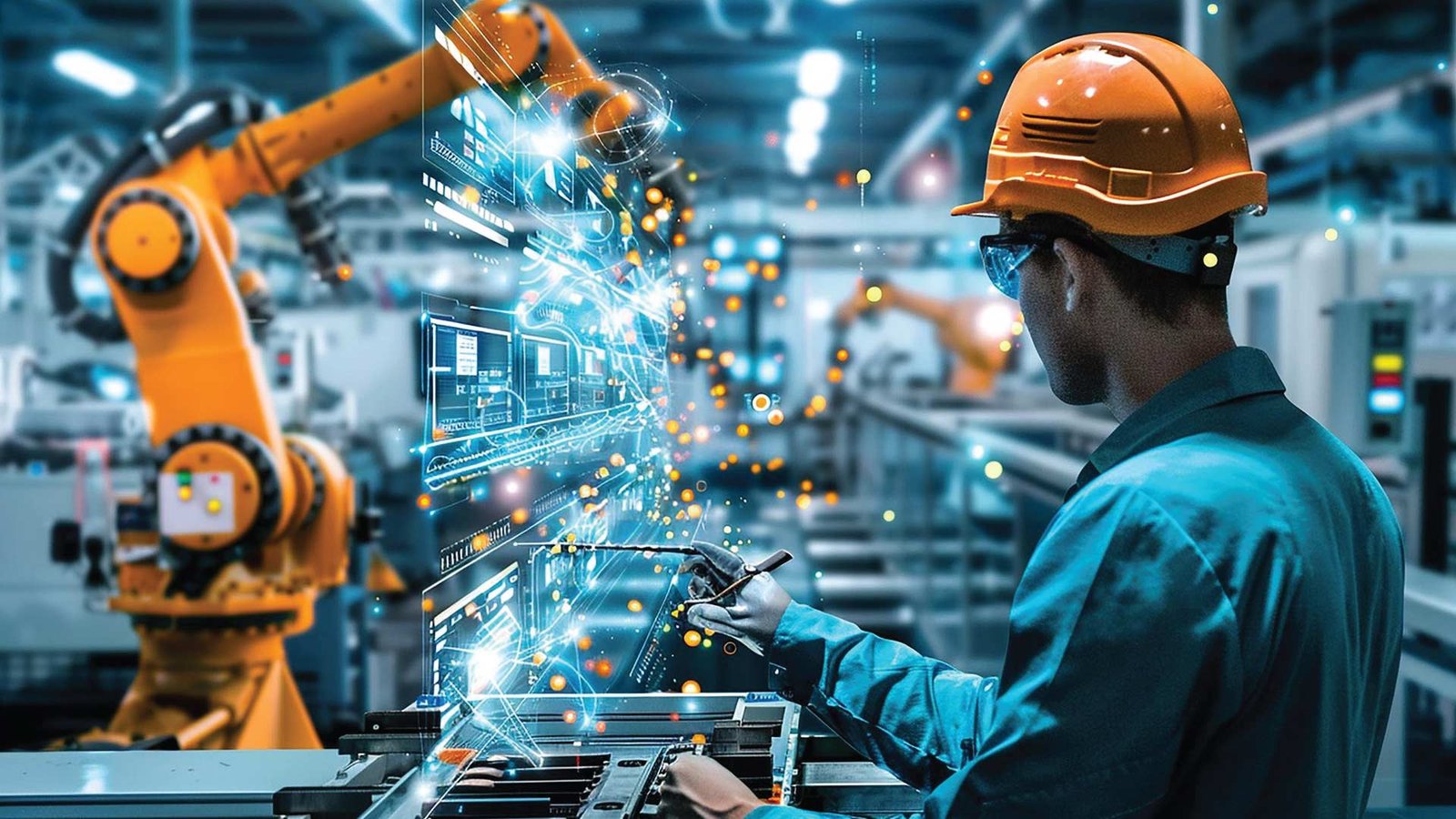
Climate stress transforms smart manufacturing while ensuring resilience in Industry 4.0 factories facing extreme weather.
The changing climate is a major driver of the development of intelligent manufacturing systems, where hurricanes cut off supply, floods overflow production plants, and heatwaves disturb electrical networks. AI’s purpose in manufacturing adapting for climate change turns fragility into strength by means of predictive analytics and automated response.
The strength of the climate change resistance in the manufacturing systems of the Fourth Industrial Revolution is based on the ability to reconfigure in real-time. AI predicts disturbances, virtual replicas (digital twins) create what-if scenarios, and connected factories do a smooth shift in their operations in the midst of ambiguity.
Table of Content:
1. The New Reality of Manufacturing Risk
2. IoT Sensing Networks as Climate Early Warning
3. AI Predictive Disruption Modeling
4. Autonomous Response Orchestration
5. Resilient Supply Chain Fabrics
6. Process Resilience
Conclusion
1. The New Reality of Manufacturing Risk
Industries historically designed their operations in such a way that they would be able to deal with the most common industrial risks: machine breakdown, lacking workforce, and changes in the market. However, nowadays, the industrial world is facing more unpredictable and wild issues brought about by climate changes like the freeze in Texas, which totally stopped the semiconductor production; heat waves in Europe, which resulted in the warping of precision components; and floods in Bangladesh, which cut off the supply of clothes. The global effects of such events are like a chain: automakers need to stop production as they cannot get chips from Asia; the pharmaceutical industry has to wait for power breaks to sterilize its products.
The usual way of handling such situations, backup power supply and extra stock, is not enough, as the frequency and intensity of the natural disasters are too high. Nevertheless, smart manufacturing systems are providing a new approach to risk management where continuous monitoring and prompt reaction transform the most serious risks into tolerable fluctuations.
2. IoT Sensing Networks as Climate Early Warning
Industrial IoT envelops the whole area of the factories with environmental sensors constantly reporting temperature, humidity, vibration, and air quality data. Edge devices have the capability of immediately discovering anomalies: they can identify rooftop ponding before the whole building collapses, excessive humidity that can ruin the electronics, and the occurrence of earthquakes even if they are very far away.
The networks are not just limited to the factory but extend to the suppliers’ forests and the transportation routes, with the ports and their conditions being monitored as well. The ability to see the impact of climate change in the case of the Industry 4.0 manufacturing systems is a first step; for instance, knowing that a flood in Vietnam is going to happen because of a typhoon can prompt the rerouting of pre-shipment instead of post-facto scrambling.
3. AI Predictive Disruption Modeling
The role of AI in adaptive manufacturing for climate change merges weather APIs, past disruptions, and supply chain telemetry into one single forecast with multiple variables. Neural network models estimate the likelihood of floods in factories depending on the amount of rain from satellites in the upstream area, while Bayesian models calculate the chances of a typhoon in Taiwan that would lead to a shortage of semiconductors globally.
Digital twins create virtual models of the entire ecosystem and run scenarios on them, such as the impacts of a heatwave on chiller cascades, filtration failures due to wildfire smoke, and drought leading to cooling being curtailed. Reconfiguration is no longer reactive but supportive of production shifting to less stressed areas of the grid during the forecasted period.
4. Autonomous Response Orchestration
Disruptions don’t affect smart manufacturing systems because they are able to take actions on their own. Production is notably retimed by autonomous scheduling, for example, medical devices during power failures and consumer electronics afterwards. Meanwhile, robots are moving stocks to the safe area to avoid floods, and ventilators are getting rid of smoke particles from wildfires without being told.
Moreover, machine learning is constantly learning through the events, which in turn will enable it to fine-tune the response playbooks. After the flood, AI will be analyzing the patterns of downtime in order to position the pumps beforehand for the next monsoon season strategically.
5. Resilient Supply Chain Fabrics
Climate change is a major factor pushing the borders of linear supply chains, while smart manufacturing systems are creating networked alternatives. AI platforms keep shadow inventories in different locations and activate backups when the main routes are blocked. Digital certificates ensure the origin of parts, which in turn quickens the process of approving substitute suppliers.
Blockchain records authenticate eco-friendly features, water-secure factories, and renewable energy-powered assembly. Smart routing finds the best combination of air/sea/rail modes, considering port shutdowns and hurricanes in real time.
6. Process Resilience
The instability of the grid requires the use of microgrids that can balance solar energy, batteries, and hydrogen at the same time, and these microgrids must be located next to the critical loads. AI in adaptive manufacturing is a big player in energy market arbitraging for the climate, stopping non-essential runs during fossil fuel peak times and discharging battery storage during power outages.
The adaptation of processes driven by AI makes it possible to compensate for the extremes of climate: recipes are modified for heat-warped substrates and humidity-affected resins. Digital chemistry speeds up the qualification of heat-resistant coatings and moisture-barrier polymers, thus guaranteeing the continuity of production during the environmental stress caused by the climate.
Conclusion
Climate stress is not a reason for manufacturing to stop but a reason for it to change. In today’s world, smart manufacturing systems that are capable of resilience against climate change are the ones that turn threats into competitive advantages. Factories that are reactive suffer from following each other down the road of failure, whereas factories led by adaptive leaders share the power to set the path to success. In fact, in any industry, adaptability is the key to relevancy.
AI’s role in adaptation to climate change creates more than just resilient enterprises; it creates ones that gain strength from the volatility. And it is the ones that learn the most from the disruptions and adapt their models are taking the lead in creating the future of resilient industries.
Discover the latest trends and insights—explore the Business Insight Journal for up-to-date strategies and industry breakthroughs!
