
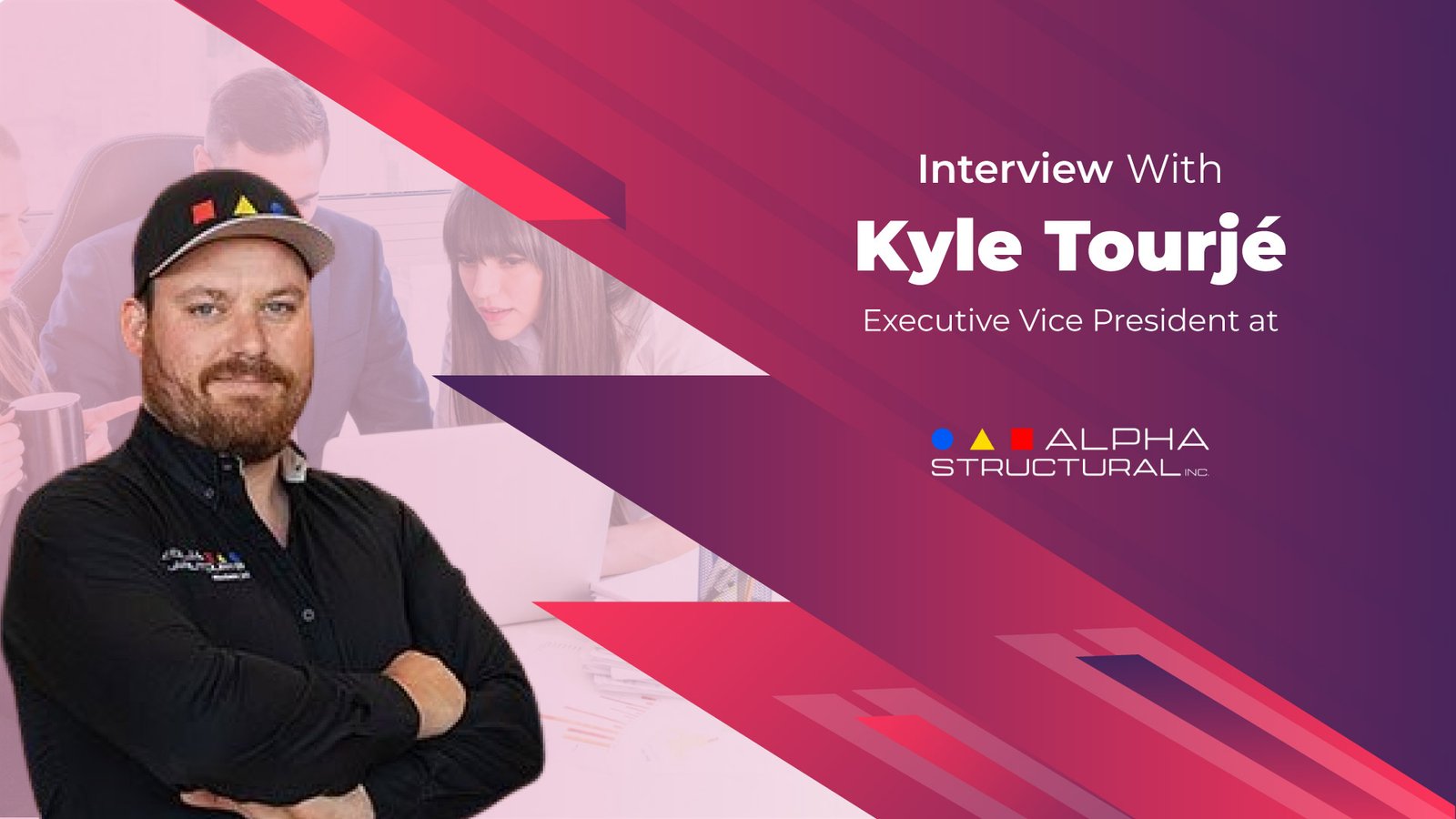
Kyle Tourjé shares insights on seismic retrofitting, structural risks, and building safer, resilient properties.
Welcome to Business Insight Journal, Kyle. We’re delighted to have you. To start, could you share a bit about your professional journey — what drew you to structural engineering and how you became involved in strengthening and preserving buildings through your work at Alpha Structural?
Thank you, I’m happy to be here.
My story is pretty simple. I was born and raised in Northeast Los Angeles—an urban and hillside area. I’m a second-generation General Engineering Contractor and now serve as Executive Vice President at Alpha Structural, a Los Angeles-based engineering and construction firm specializing in foundation repair, hillside stabilization, seismic retrofitting, and structural upgrades. I run the business alongside my father, Dave, who is also a General Engineering Contractor, as well as my sister and my mother.
I grew up in this industry and on job sites with my father and sisters, helping the foremen and crew on cleanup and concrete/foundation work, and sometimes not helping much at all, which probably stressed out a lot of people, considering how young I was. I’ve been at Alpha Structural for over 15 years now. Today, I oversee our technical operations, including engineering, forensic engineering, construction project management, and entitlements and approvals.
This is the business I’ve known since childhood, and I genuinely love it. It’s a challenging, high-risk industry, but it’s also incredibly rewarding. Not just professionally, but in the broader impact it has on the real estate market and engineering/construction fields.
Retrofitting historic or architecturally sensitive buildings can be incredibly complex. What key challenges do building owners and engineers face when trying to balance preservation with modern safety standards?
Retrofitting historic or architecturally sensitive buildings is a careful and specialized undertaking. The main challenge is strengthening structures to meet modern seismic standards without compromising the features that give them their character. Many older buildings have decorative masonry or stone elements that were never designed to handle earthquake forces, so solutions have to be precise and discreet.
There are also real logistical and financial hurdles. These buildings are often occupied, which means navigating tenant protections, long-term leases, and business disruptions, all while managing limited funding options for seismic upgrades. On top of that, decades of deferred maintenance can reveal hidden structural issues once work begins.
The most successful projects happen when Architects, Engineers, and Contractors collaborate early, ensuring solutions are safe, buildable, cost-conscious, and respectful of the building’s original design.
Budget is always a major concern for earthquake retrofits. What strategies should building owners adopt to balance the often-high costs of retrofitting with ongoing maintenance and operational budgets?
The key is to be proactive. Retrofitting works best when it’s treated as a long-term investment and integrated into planned maintenance, renovations, or tenant improvements, rather than handled as a one-off compliance expense or conditional project to secure insurance or financing.
Combining structural upgrades with other planned major renovations or improvements helps avoid duplicate costs and tenant disruption, and in some cases can even create value through energy efficiency improvements or better use of existing space. For occupied buildings or tighter budgets, phased retrofits that prioritize critical life-safety upgrades can help manage cash flow while reducing immediate risk. Early collaboration between Architects, Engineers, and Contractors is also essential, allowing teams to value-engineer practical, buildable solutions. And it all starts with a thorough structural and architectural evaluation, so owners understand what truly needs attention before costs escalate.
For owners or asset managers looking to strengthen their properties, what are some of the most affordable and high-impact retrofitting steps — such as bracing and bolting, steel frame retrofit, or concrete retrofits — that can dramatically improve safety and resilience?
For most homeowners, especially those with wood-frame houses, some of the most affordable retrofitting steps can have an outsized impact on safety. Bracing and bolting are at the top of that list. Bolting the home’s wood framing to its concrete foundation helps prevent the house from sliding during an earthquake, and adding shear walls significantly improves its ability to resist lateral movement.
For commercial, industrial, or high-rise owners, strengthening key connections, like roof-to-wall ties, installing steel frames, concrete shear walls, or fiber-reinforced polymer systems, also makes a tremendous difference by restraining the building or ensuring it moves uniformly, instead of pulling apart under seismic forces. This also applies to restoration work on buildings with brick or masonry elements, such as targeted repairs like repointing degraded mortar, which can dramatically reduce collapse risk.
The most important first step, though, is a professional structural evaluation. It helps owners focus their budget on the highest-risk vulnerabilities and invest in upgrades that deliver the greatest return in safety and resilience.
Aging buildings often hide critical structural issues. How can structural engineers effectively identify and reveal these hidden vulnerabilities before they lead to serious problems?
The most effective way to uncover hidden structural issues is through a professional evaluation that looks beyond what’s visible on the surface. Engineers assess how a building was originally designed, the era it was built in, and how it’s been maintained over time, and employ visual and forensic tools, as well as advanced analysis and modeling, to determine how a building is currently performing, and how it will perform in the event of a significant seismic event.
They look for key red flags like deteriorated masonry, corrosion in concrete reinforcement, foundation or drainage issues, and façade elements that may not be properly anchored. They take field data and use as-built plans to model accurate seismic performance using advanced modeling software and calculations—all to predict realistic scenarios. Collaboration between engineers and contractors is also critical, since many vulnerabilities are hidden behind walls or in crawl spaces and only become clear through hands-on field investigation.
Despite well-documented risks, many high-risk structures — such as soft-story, unreinforced masonry and non-ductile concrete buildings — remain unstrengthened. What factors contribute to this, and what can be done to encourage more proactive retrofitting?
A lot of these buildings remain unstrengthened because of a mix of complacency, cost, and logistics. Many owners assume a major earthquake won’t happen on their watch, and retrofitting can feel like a large upfront expense with limited financial incentives. On top of that, long-term leases, tenant protections, and disruption concerns make it difficult to access occupied buildings and move projects forward.
Encouraging proactive retrofitting starts with reframing it as an investment rather than a penalty. Integrating seismic upgrades with planned renovations or tenant improvements helps control costs and minimize disruption. Stronger financial incentives, early collaboration between engineers and contractors, and clear structural evaluations can also go a long way in helping owners act before small risks turn into major liabilities.Frame-to-foundation connections and inadequate column/floor design are often overlooked during construction or renovation. Why are weak connections so dangerous, and what should property owners understand about the risks they pose?
Frame-to-foundation connections and column/floor design are critical because they serve as the support for the structure and its occupants, but also, in most scenarios, serve as the lateral support of the building. This is the component that absorbs earthquake forces during an earthquake. When those connections or columns are weak or missing, the walls, roof, and foundation can move independently, they can shear, or have dramatic column failures, which dramatically increases the risk of collapse or irreparable damage.
For property owners, it’s important to understand that strengthening these connections isn’t just about code compliance— it’s one of the highest-return safety investments you can make. Simple measures like bolting the frame to the foundation or adding shear walls are relatively affordable, especially in wood-frame buildings, and can prevent catastrophic failure while buying valuable time for occupants to evacuate. In many cases, these upgrades are far less costly than repairing the damage after the fact.
As urban areas continue to evolve, how can cities and local governments better incentivize retrofitting efforts to improve public safety while preserving architectural heritage?
Cities can make real progress by pairing safety requirements with meaningful incentives. Mandates alone often put owners in a difficult position, especially when retrofitting comes with high upfront costs and regulatory complexity. Providing access to low-interest loans, grants, and flexible financing, especially for small owners and historic properties, can make proactive retrofitting far more achievable.
Local governments can also help by streamlining permitting, encouraging adaptive reuse, and allowing value-add improvements that help offset retrofit costs. Just as important is supporting modern, minimally invasive engineering solutions that strengthen buildings without altering their historic character. When cities take a collaborative approach and align resilience with sustainability and long-term urban planning, retrofitting becomes a shared investment in public safety rather than a burden.
On a personal level, what leadership philosophy or guiding principle has helped you navigate the technical and operational challenges of large-scale structural projects?
My guiding principle is simple: fix it right, fix it once. Large-scale structural projects leave very little room for shortcuts, and I believe the responsibility we carry demands precision, accountability, and attention to detail from start to finish. In the residential market, the home is the client’s primary investment, let alone any sentimental attachment. We must view these buildings as our own to deliver the right solution.
We stand behind the quality of our work and take the time to do things correctly the first time, even when that means more upfront effort. That approach reduces risk, protects people, and ultimately delivers better outcomes for owners, occupants, and the communities we serve.
Finally, Kyle, any closing thoughts you’d like to share with our readers about the importance of proactive retrofitting and how property owners can take practical steps toward safer, more resilient structures?
Proactive retrofitting isn’t about checking a box. It’s about staying ahead of risk. We’ve been fortunate to avoid a major earthquake in a dense urban area for decades, but that luck has also created complacency. Structural issues don’t wait for disasters, and deferred maintenance alone can put lives and properties at risk.
The most practical step owners can take is starting with a professional structural evaluation to understand where their real vulnerabilities are. From there, integrating retrofits into planned renovations, collaborating early with engineers and contractors, and taking a phased, strategic approach make the work far more manageable. Investing in resilience now gives owners control over timing, cost, and outcomes, instead of letting those decisions be dictated by an emergency.
Earthquake resilience isn’t just a safety precaution—it’s an imperative for property owners. Acting now can protect lives, reduce liability, and minimize downtime after the next big quake.

Kyle Tourjé
Executive Vice President at Alpha Structural, Inc.
Kyle Tourjé is a second-generation contractor specializing in structural retrofitting, repair, and geohazard mitigation throughout Southern California. As Executive Vice President of Alpha Structural, Inc., he oversees all engineering and construction operations. Having grown up in the trade and with over 15 years of experience—including personally repairing and inspecting over 6,000 structures—Kyle combines hands-on construction and field engineering expertise with leadership in real estate and disaster response. His work bridges the gap between engineering solutions and the realities of property ownership and management, code compliance, and disaster response. With a background spanning construction, insurance claims, and litigation support, he applies practical solutions to California’s evolving structural, legal, and environmental challenges. Kyle’s focus is on advancing straightforward, lasting solutions that improve safety and resilience for communities across the region. For more about Alpha Structural
